Dumka · Alpha
A whiteboard that keeps its word.
Dumka is a real-time whiteboard for one-to-one lessons that I designed and built. This is the one rule it is built around, and how the rest follows from it.
- Edit
- Browser journal
- Room commits
- Acknowledgement
- Saved
What it’s for
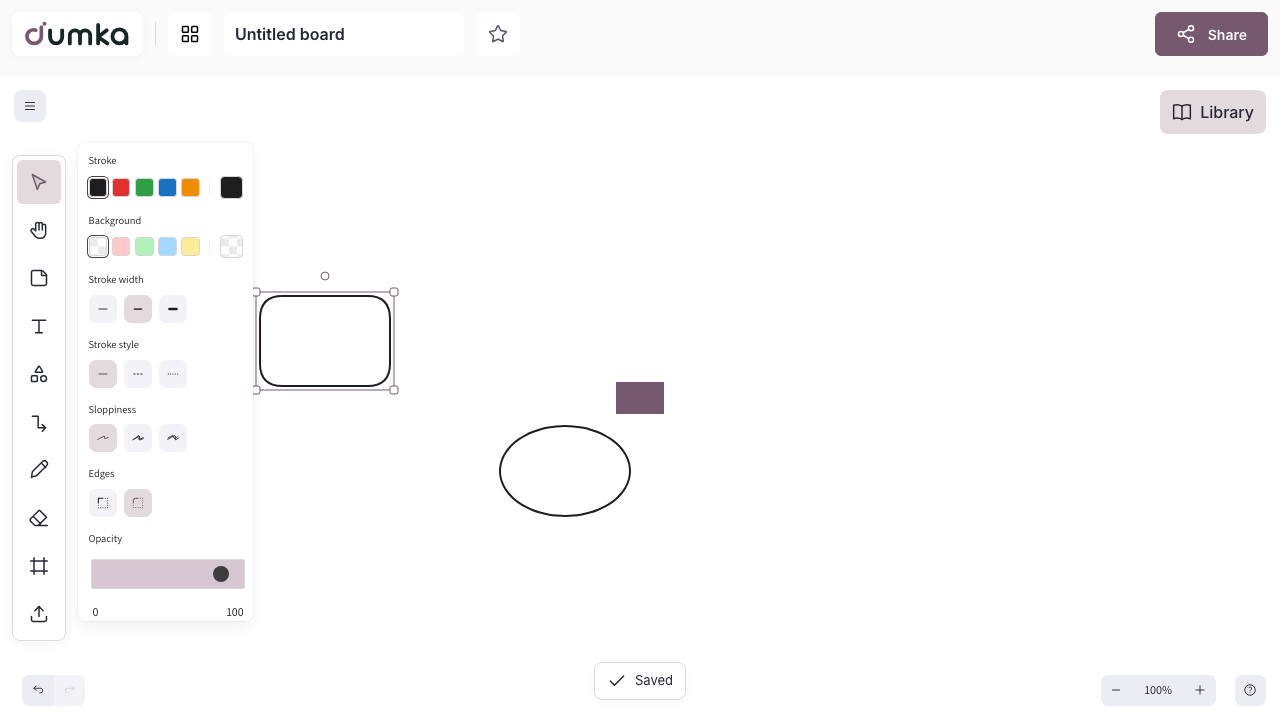
A lesson happens on one shared board: pictures, notes, exercises, and drawing. Each student has their own board, and the teacher joins it. The first version is sized for about 50 students.
A lesson is a bad place to lose work. If a student writes an answer and the tab reloads, the answer has to still be there.
The rule
It would be easy to show Saved the moment an edit leaves the browser. Dumka waits. The server writes the edit to the board’s storage, then acknowledges it, and only that acknowledgement turns the label to Saved.
So Saved describes what is stored, not what was sent. Most of the design below exists to keep that sentence true.
How it’s built
One room per board
Every board is its own Cloudflare Durable Object with SQLite storage. It holds the live connections, checks each command against the board’s access list, and is the single authority for that board’s content.
Numbered edits
Each client numbers its edits. The room commits an edit, then replies with an acknowledgement and the canonical result. An edit that arrives twice is recognized and applied once.
A journal in the browser
Until an edit is acknowledged it stays in IndexedDB, scoped to the account, the board, and the tab. After a reload or a dropped connection, the client replays what is missing.
Three stores, three jobs
D1 decides who may open a board. The room’s SQLite holds the board itself. R2 holds uploaded materials privately, and a file is served only after an access check.
Yjs where text merges
Documents and Kanban boards inside a lesson merge concurrent edits with Yjs. The canvas uses the acknowledged protocol above.
How I know it holds
Property-based tests generate random sequences of lost acknowledgements, reconnects, duplicate deliveries, and room restarts. They run against the real connection code and room storage, and assert that every client ends up with the same board.
A local probe ran the planned class size: 50 boards and 100 connections, a student and a teacher on each. All 100 edits were acknowledged and reached the other person, and none appeared on another board. That was one round on a development machine, not a load test.
What isn’t done
Dumka is an alpha. Sustained load in production, behavior on physical phones and tablets, and a backup-and-restore drill are still untested.
How I work on it
I build Dumka with coding agents. The repository carries the rules they work under, lint and type gates run on every change, and release notes keep what was implemented apart from what was verified in production.
Built with
TypeScript · React · TanStack Start · TanStack Router · TanStack Query · Hono · Cloudflare Workers · Durable Objects · D1 · R2 · WebSockets · Excalidraw · Drizzle ORM · Better Auth · Yjs · Tailwind CSS · Vitest · Playwright